



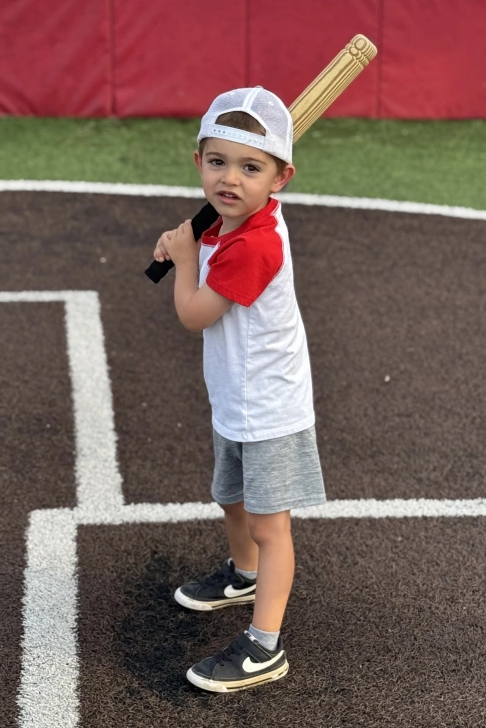
In December 2024, two-year-old Luka Smart was playing with his dad, Jonathon, when the little boy took a tumble and hit his head on the floor. He cried hard, but within 10 minutes he was back to himself—grabbing one of his six beloved bats, each with its own ball, ready for his favorite pastime: batting practice.
“We wake up, and he wants to play baseball,” said his mother, Morgan, a cardiac sonographer at Baylor Scott & White Medical Center – Hillcrest.
“If you walk in the door—even if he’s never met you—he’ll hand you a ball and say, ‘Throw it to me,’” Jonathon added. “He hits super hard. Inside, outside—doesn’t matter. He’s always hitting.”
Because Jonathon has himself experienced multiple concussions, he monitored Luka carefully overnight. By morning, Luka complained of a headache, but after some Tylenol he made it through the day at day care.
That evening, while Morgan was out with her mom and sister, Jonathon was tossing pitches to Luka when the little boy suddenly dropped his bat, scrunched his face and erupted into screams.
Jonathon checked his eyes—and one wasn’t reacting to light.
A critical moment
He called Morgan, then rushed Luka into the car and headed straight for the emergency department at Baylor Scott & White Medical Center – Hillcrest. On the way, Luka began vomiting uncontrollably and passed out. As a patrol sergeant with the Bellmead Police Department, Jonathon was able to alert dispatch so the hospital could prepare. In the exam room, the triage nurse immediately recognized how sick Luka was and quickly escalated the case.
As she gathered details, Luka vomited again. His pale, sweaty appearance made it clear this was not a typical pediatric head injury.
Instead of waiting for a physician to respond, she went directly to the nurse’s station and pulled in the nearest available doctor, who was ending their shift. With the urgency clear, the physician hurried to Luka’s bedside and placed an order for an emergency CT scan.
The scan confirmed an epidural hematoma, a life-threatening accumulation of blood between the skull and brain. The care team quickly began coordinating emergency transport to Baylor Scott & White McLane Children’s in Temple.
Jonathon waited anxiously outside the room. “I heard chairs scattering, and the team came out and said he needed to be in the operating room five minutes ago,” he said.
The last of Jonathon’s composure broke. Through tears, Jonathon called Morgan to tell her their son had a brain bleed and needed to be flown to Temple for emergency surgery.
“I’m not gonna lie—I did not hold it together,” said Morgan. “I was an emotional wreck. I’ve seen families lose it for their loved ones, and now I understand. I couldn’t control myself. I was just so scared for Luka, and I didn’t know what to expect. My field is with the heart, not with the brain.”
Flight to McLane Children’s
Meanwhile, coordinated teams across Baylor Scott & White began moving at full speed. McLane Children’s was notified, and trauma, neurosurgery, pediatric surgery, radiology, and transport services all mobilized simultaneously. Radiologists reviewed Luka’s scans to prepare the surgical team.
A stroke of luck was on their side: a pediatric transport crew was already en route to BSW – Hillcrest for a less urgent patient and was able to pivot to Luka’s case.
The transport team quickly reorganized, switching gears from their original assignment to an emergency neurosurgical transport. They had all necessary supplies ready and moved with practiced agility.
When they arrived, they found Jonathon holding a limp Luka to keep him breathing. The sight was daunting even for seasoned professionals. They allowed the parents a few moments to love on Luka before taking him to the helipad, knowing how uncertain the outcome might be. Before liftoff, the team quietly reassured Jonathon and Morgan that Luka was in capable hands and that they would do everything possible for him.

“It was definitely the hardest decision in my life to let him go to them, and that’s when I lost it,” said Jonathon. “When they put him on the stretcher to take him to the helicopter, I went to my knees and started crying.”
He and Morgan prayed the entire drive to Temple. Above them, Luka fought for his life in the helicopter.
Every second counts
At McLane Children’s, the team bypassed the emergency room entirely and brought Luka straight to the waiting operating room. Blood products, medications, equipment, and documentation were already anticipated and prepared before his arrival. He was intubated and prepped for surgery within minutes. Inside the OR, every role—from surgeons to residents to anesthesiologists, nurses, and techs—worked in sync. There was no time to spare—speed was Luka’s best chance at avoiding lasting brain damage.
The surgery, expected to last more than three hours, was completed in just two. When the surgeon entered the waiting room with a smile, Morgan collapsed into tears of relief.
“It was instant relief, and I just cried even harder. I knew my baby was going to be OK,” she said.
Luka was extubated the next day. He was groggy when the transport team visited with a die-cast toy helicopter, but he was already well on the road to recovery.
The Smart family stayed in the hospital for four days, exhausted but grateful. Luka was discharged on December 22—just in time for Christmas.

Over the next few months, he completed physical and occupational therapy and was fully cleared in April. Although he initially lost the use of his left hand, he worked tirelessly until he regained full strength and is now back to slugging baseballs at every opportunity.
“He is living his best life,” said Morgan. “He’s actively running everywhere and getting into everything just like your normal 2-year-old. He’s nonstop. He goes, goes and goes, 24-7. That turned out to be the worst day of our entire life…”
“But to be home for Christmas, just us three, was one of the best feelings,” Jonathon added. “We just can’t thank the Baylor Scott & White staff enough.”